
Local government
CIVIX: one operations system for the whole city, with a person on every decision
CIVIX is a city operations system. It watches the sensors and controllers a city already has across 22 domains, from traffic signals, cameras and dispatch to water, power, stormwater, transit, 311, permits and finance, and turns what they report into plain next steps. Alerts come with the evidence and a proposed action for a person to approve, every signal timing change passes seven safety checks and reverts unless someone confirms it, and every decision is sealed with a hash anyone verifies. It is for city managers, public works and traffic operations teams, and emergency dispatch.
The demo runs on one sample company that resets itself every 30 minutes. Nothing is ever sent.
Why we built it
A city's trouble rarely stays in one department. A burst main floods a street, the street closure backs up traffic, the backup slows the ambulance, and the calls pile up at 311 while the repair bill starts climbing. Each team sees its own piece on its own screen. CIVIX puts the whole picture in one place, proposes the next step, and leaves every decision that matters with a person.
See it
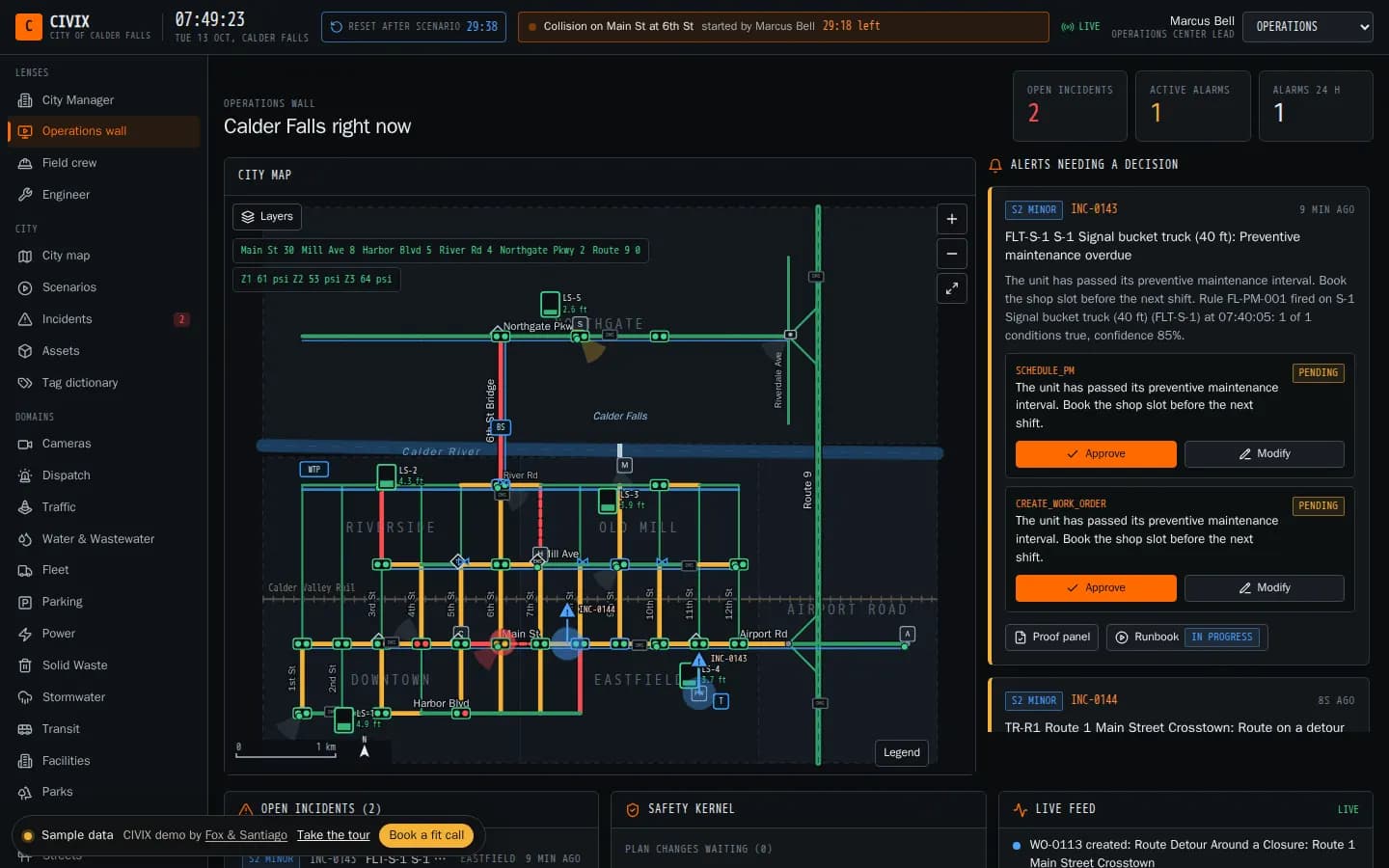
The demo is Calder Falls, a simulated city that every visitor shares. Open the operations wall, then start a scenario from the Scenarios page: a collision at Main and 6th, a water main break on Mill Ave at rush hour, a storm cell, a wrong-way driver on a highway ramp or a lift station backup. Watch the city respond, approve the timing plan in the safety kernel, and ask the Council what happens next.
How it works
The whole city on one wall
Signals, water and wastewater, power, stormwater, buses, crews and more sit on one live map, each on its own layer. When a rule fires, an alert card arrives with the readings behind it and the actions CIVIX proposes, and the operator approves or modifies each one.
A crash on camera, and the response already moving
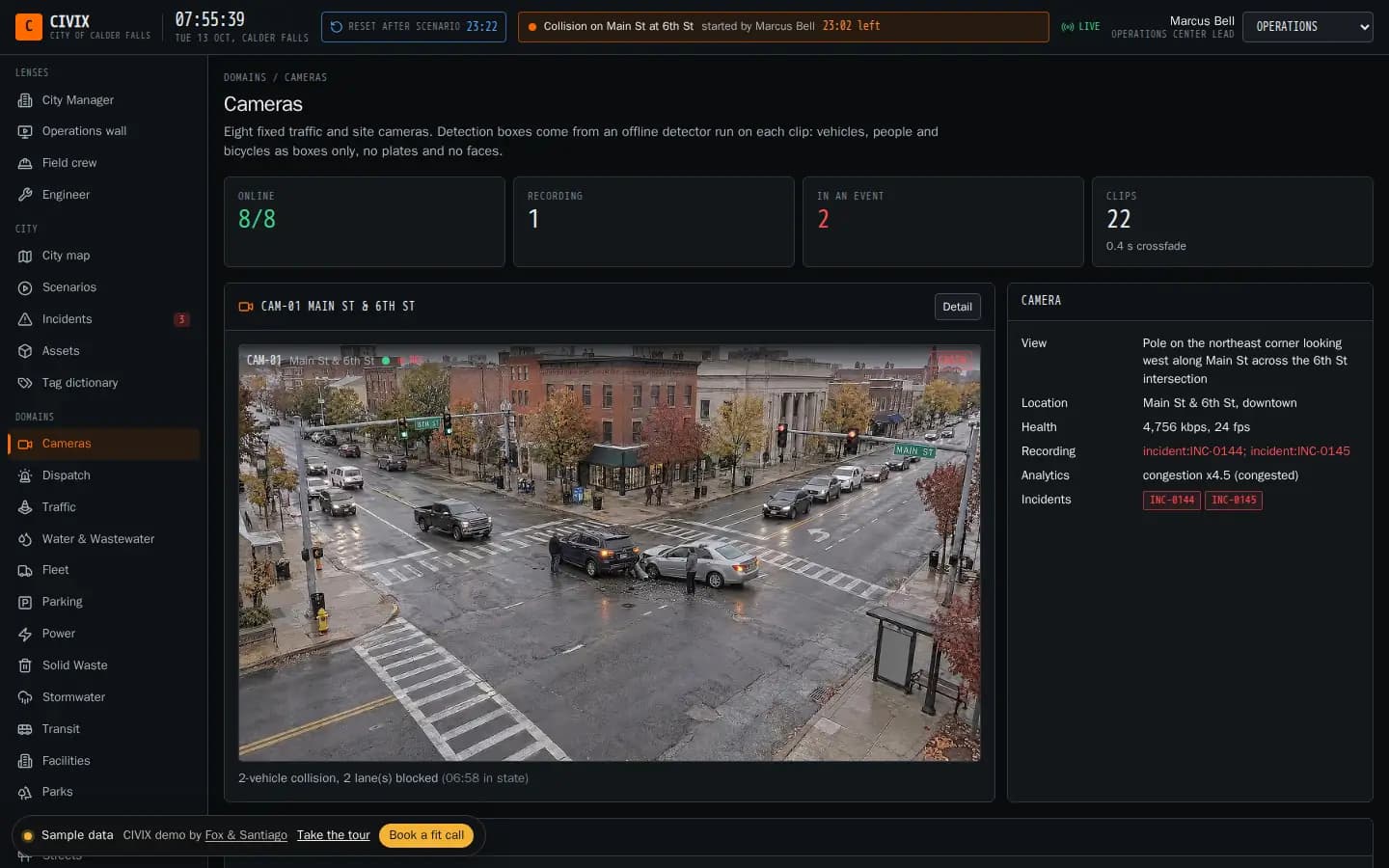
The camera at the intersection sees the collision. Within seconds CIVIX opens the incident, sends police, EMS and a tow with green lights along their routes, posts the detour and the message signs, and reports the closure to Waze and Google Maps through the city's Waze for Cities feed, so drivers route around it before they reach the queue. The road loops confirm it afterwards. Detection counts vehicles, pedestrians, bikes, stopped vehicles and wrong-way drivers, nothing more.
Signal timing waits for a person
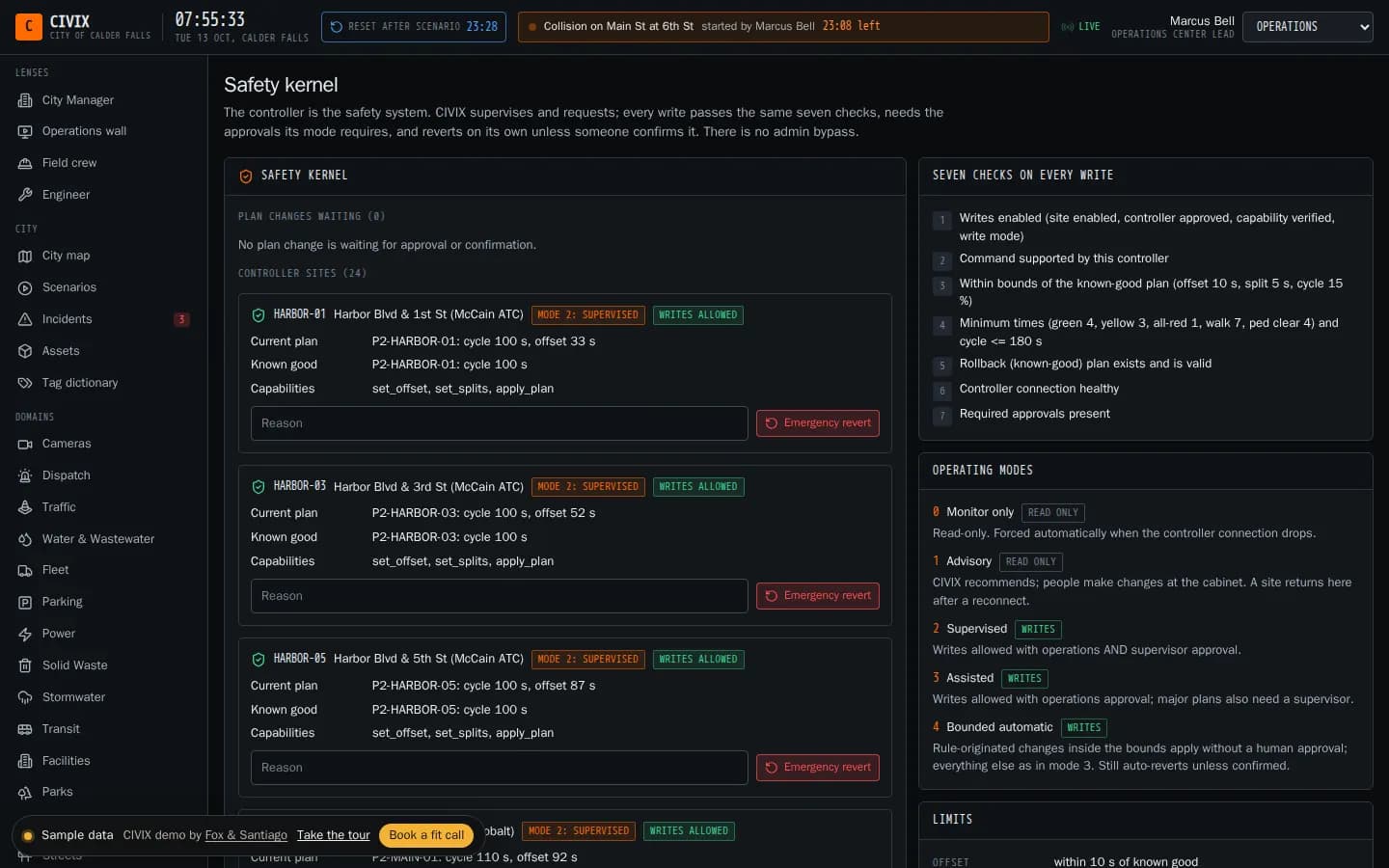
The only step that waits is the signal timing plan. Operations and a supervisor approve it in the safety kernel, where every change passes seven checks: writes enabled, a supported command, within bounds of the known-good plan, minimum green, yellow, all-red and walk times, a rollback plan, a healthy controller connection and the required approvals. Unless someone confirms the change, it reverts to the known-good plan.
Runbooks that stop at the dangerous step
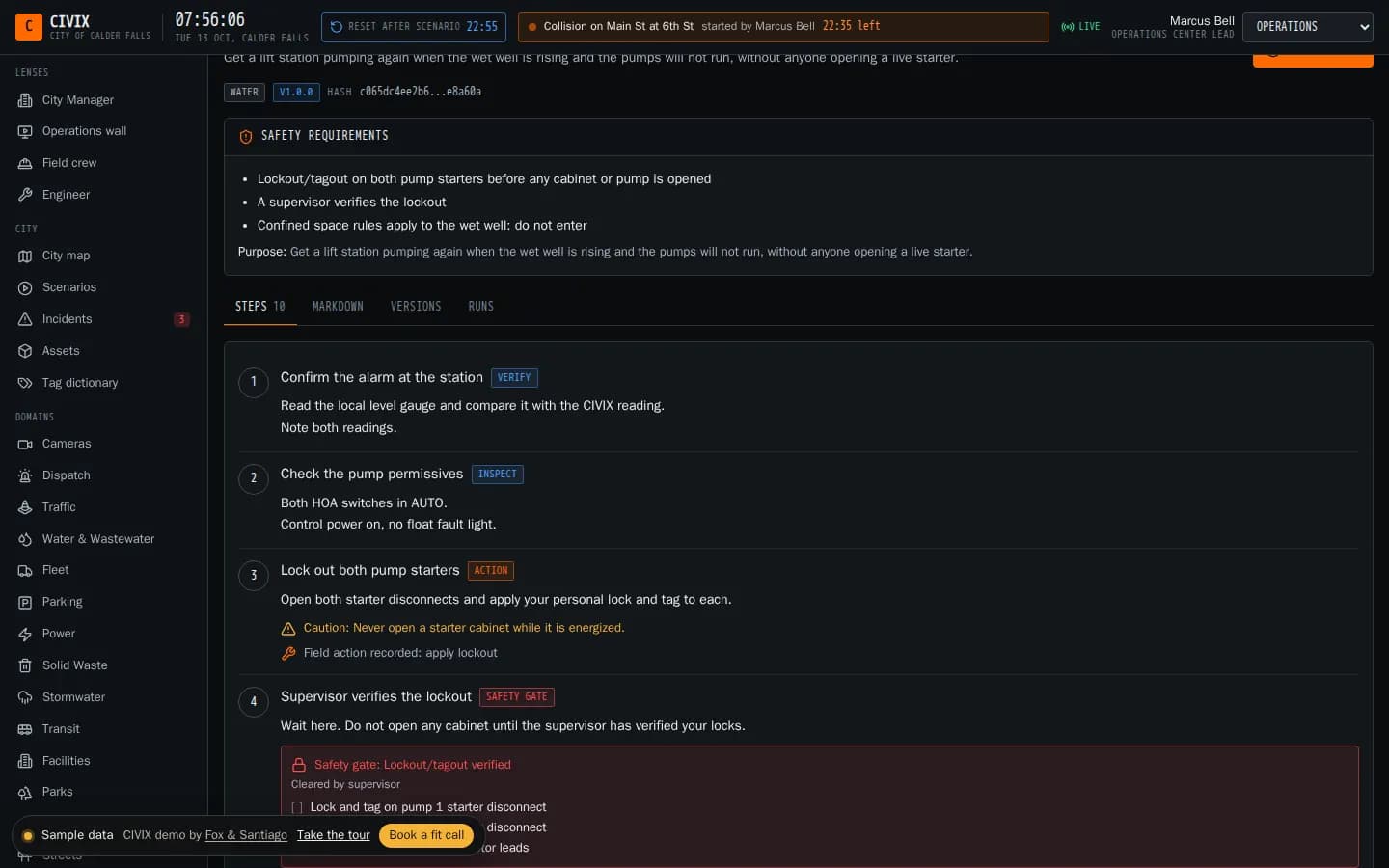
The crew's phone shows only their own work orders, with every runbook step in plain words. Hazardous steps sit behind a gate, such as lockout and tagout on a pump starter or a supervisor sign-off, and the runbook does not move on until the right person clears it.
See one failure spread before it does
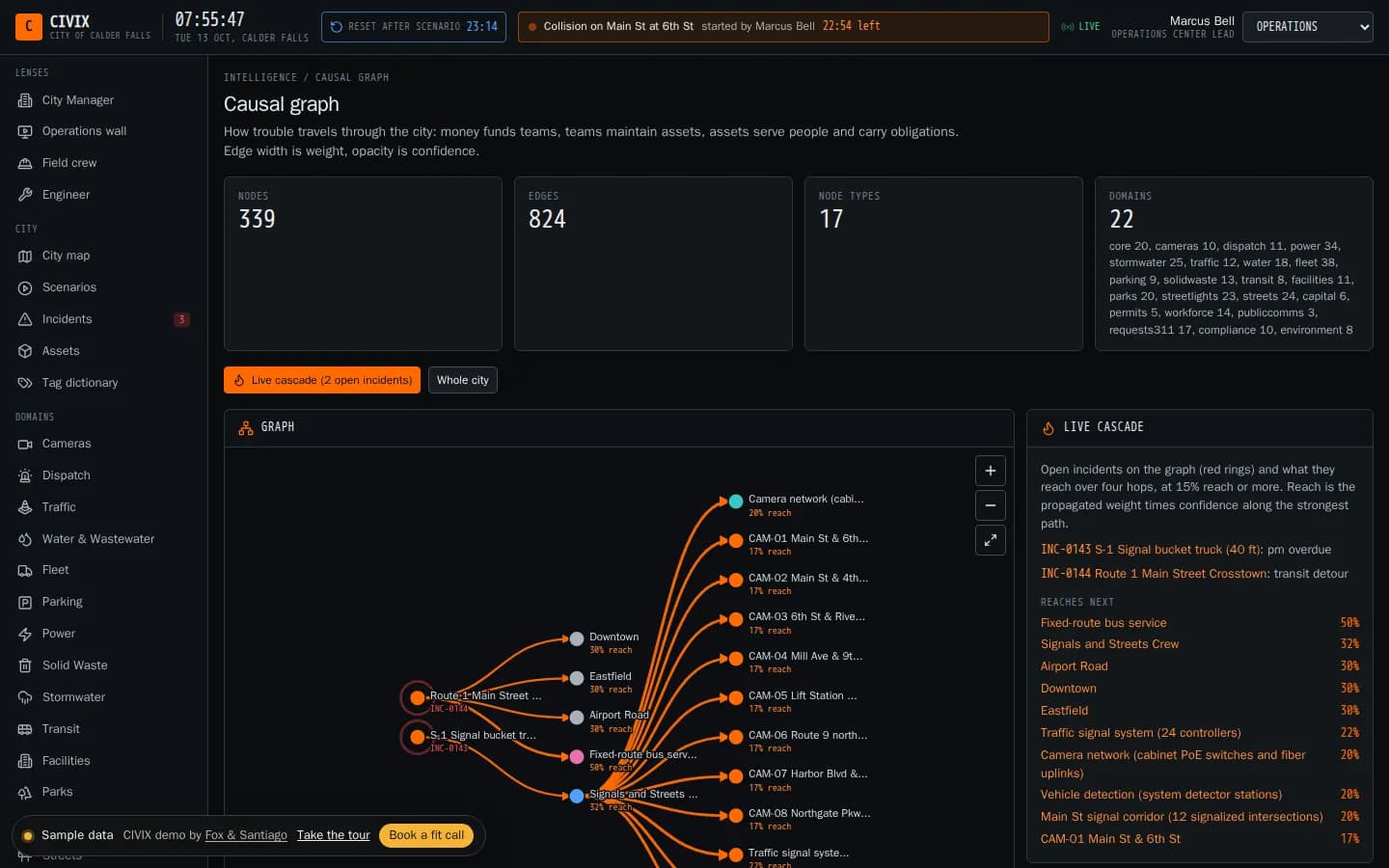
The causal graph links assets, services, crews and budgets across every domain, so a water main break at rush hour shows its path into traffic, fire coverage, streets, 311 and the budget. Ask the Council a what-if, such as cutting the streets budget 15%, and CIVIX runs 25,000 Monte Carlo runs per option while five seats weigh in on safety, operations, data, precedent and cost.
Who it is for
- City managers and their leadership teams
- Public works, utilities and traffic operations
- Emergency dispatch centers
Built by Fox & Santiago as our own product.
Questions people ask
What problem does CIVIX solve?
A city runs on dozens of separate systems, and each department sees only its own. When a main breaks or a crash blocks a street, the effects land on traffic, dispatch, crews, residents and the budget at once, and people piece it together by phone. CIVIX puts every domain on one live picture, tells each person what to do next, and keeps a record of who decided what and why.
Does CIVIX take control of the traffic signals?
No. The signal controller stays the safety system. CIVIX requests timing changes, every request passes seven safety checks and the approvals its operating mode requires, and a change reverts to the known-good plan unless someone confirms it. There is no admin bypass, and an emergency revert returns any intersection to its known-good plan in one step.
Do drivers hear about a crash or closure on their phones?
Yes. CIVIX keeps the city's live feed for Waze for Cities, which shows partner closures and crashes to Waze and Google Maps drivers. A crash goes in the moment its incident opens, a closure that blocks every lane routes drivers around it, and the item comes off when the road reopens. The city registers the feed with Waze once.
What do the cameras detect?
Counts of vehicles, pedestrians, bikes, stopped vehicles and wrong-way drivers, used to confirm incidents and traffic conditions. CIVIX reads no license plates, recognizes no faces, and does no predictive policing or enforcement.
How does anyone check why CIVIX recommended something?
Every alert is sealed in a proof panel: the readings, the rule clauses that matched, what would prove it wrong, and a SHA-256 hash. Press Verify and CIVIX recomputes the hash in front of you. Every action lands in a hash-chained audit log.
Is the demo the real software?
The demo runs CIVIX on Calder Falls, a simulated city. Its sensors, controllers, crews and vehicles are simulated, and the camera footage is AI-generated. Everything CIVIX does with them is the real logic: rules fire on live readings, dispatch routes over the road network, the safety kernel rejects bad changes, and proof hashes verify. The Council seats give prepared answers built on each live Monte Carlo run. Nothing is sent to anyone, every visitor shares the same city, and it resets every 30 minutes. A 14-step guided tour walks you through it, and Run it for me plays any scenario from the first alert to the closed incident, the way a city manager would run it.
The demo runs on one sample company that resets itself every 30 minutes. Nothing is ever sent.
Next step
Talk to us
Start with a free twenty-minute fit call. If the workflow, the sponsor and the path to access are real, the next step is a Workflow Spec.
Fox & Santiago, Genesee, Idaho. We work nationwide, for clients across the United States, from our headquarters in Genesee, Idaho.