Industry
Industrial service companies
Industrial service companies usually break at the daily field ticket: crews work inside a customer's plant on time and materials, the customer's rep signs a paper ticket, and the office rebuilds hours, equipment and extra work from it days later. Fixing it means the ticket is written once on site, signed on site, and becomes the timesheet, the job cost and the invoice line without being retyped.
How work moves in industrial services
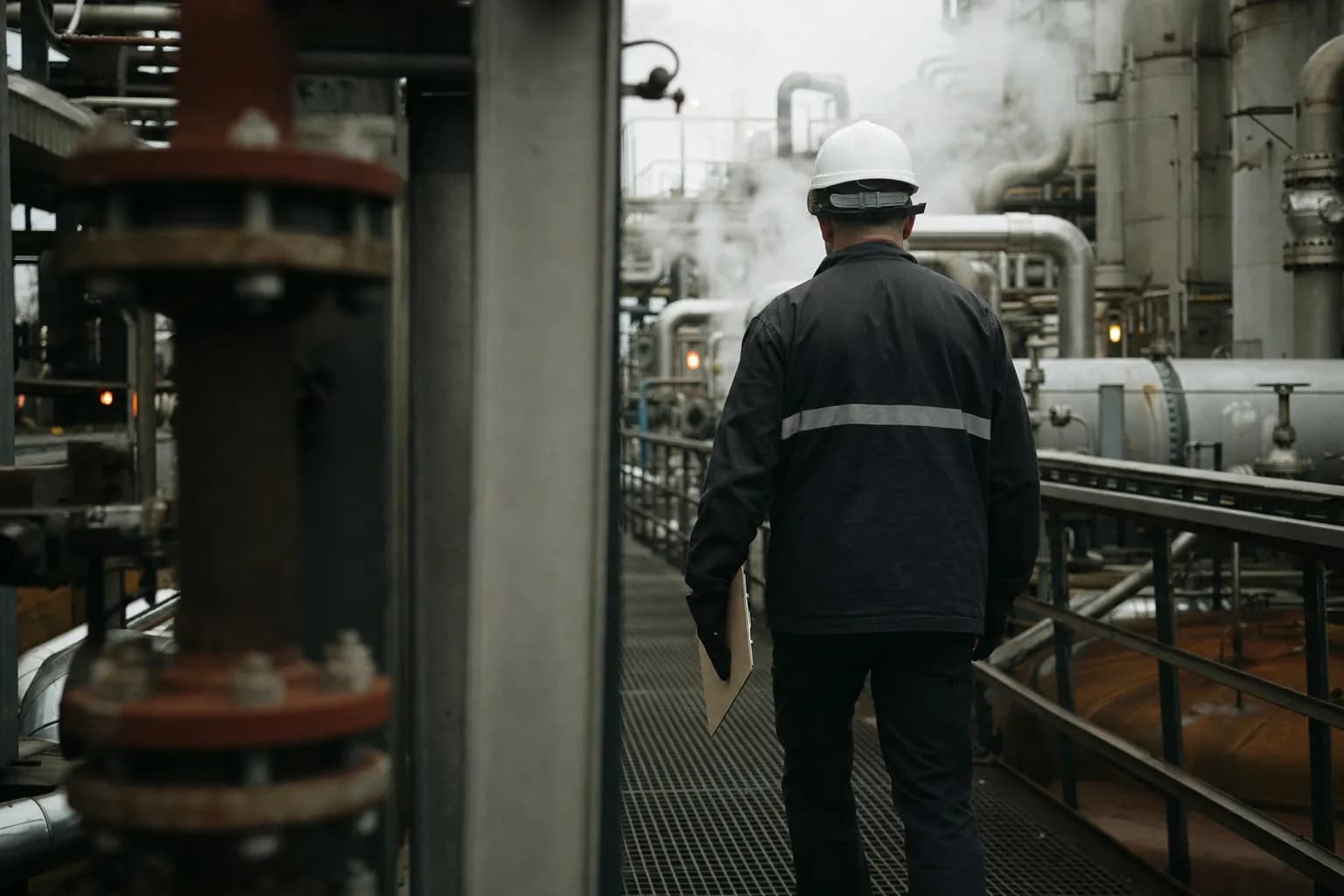
Most of the work happens inside a plant that belongs to someone else. A customer's maintenance planner or project lead calls in a scope: clean these exchangers, reline this chute, support this outage. Sometimes it arrives as a purchase order with a rate sheet attached. Sometimes it arrives as a phone call on a Sunday.
The office builds a crew. That means people with the right site badges and training cards, the right equipment, and a supervisor who knows the plant. The crew signs in at the gate, sits through the site orientation, and waits for the customer's permits before touching anything. Then the day runs on the customer's clock, not yours.
At the end of each shift, the supervisor writes a daily field ticket: who worked, how many hours, what equipment ran, what materials were used, and any work outside the original scope. The customer's rep signs it. The ticket goes into a truck, then a folder, then the office. There, someone turns it into payroll hours, a job cost entry and, eventually, an invoice that has to match the customer's PO and rate sheet line by line.
Where it usually breaks
Tickets reach the office late and get retyped
The ticket is the source for three systems, and each one gets a hand-typed copy. Hours are keyed into payroll, costs into the job, lines into the invoice. That is the re-entry trap. The guide on job tickets that reach the office late shows how to measure the lag from shift end to office entry.
Extra work is agreed on the deck and lost by billing
The customer's rep asks the crew to do one more thing while they are there. The supervisor says yes. It may or may not make the ticket, and if it does, it may not carry the rep's name or the reason. By the time the invoice goes out, nobody can prove it was asked for. That is approval drag in reverse: the approval happened, but nothing recorded it. See the guide on extra work that never gets billed.
Hours on the ticket do not match hours on the timesheet
Gate logs, the supervisor's ticket and each worker's own timesheet tell three versions of the day. Payroll uses one, billing uses another, and the customer audits against a third. That is the field-to-office split. The guide on technician hours that don't match timesheets covers how to find which record is drifting.
Crew qualifications live in someone's head
Which workers have current site training for which plant? Often one person in the office knows, and the answer is in a spreadsheet only they update. When a call comes in at night, the crew is built from memory. That is the invisible queue applied to people. The guide on safety and compliance paperwork that is always behind is the place to start.
The first workflow we usually look at
The daily field ticket, from the supervisor's hands to the invoice line. We follow a week of tickets from a few crews: when each was written, when it was signed, when it reached the office, how many times it was typed, and what changed between the ticket and the invoice. We sit with the billing clerk while they match tickets to the customer's rate sheet. The questions they ask the supervisor by phone are the fields the ticket is missing.
When the ticket is written once on site, against the customer's rates, with extra work tagged and signed, the office stops rebuilding the day from paper.
The systems in the picture
An industrial service company usually runs some mix of these:
- An accounting or ERP system with job costing
- A separate payroll system, sometimes with its own time entry
- Paper or carbon-copy field ticket books
- Spreadsheets of rate sheets, crew training records and equipment
- The customer's own portals for purchase orders and invoice submission
- Phones, group texts and email for crew coordination
What a Workflow Spec looks like here
A Workflow Spec for an industrial service company is $15,000, fixed, and done on site. We go where the crews go, as far as the customer's site rules allow, and we sit in the office where the tickets land. We interview supervisors, the dispatcher who builds crews, payroll and billing. We measure how long tickets take to become invoice lines today and what falls off along the way. You get the workflow map, the business case, an adoption design built around the supervisors who would carry the tool, and a fixed proposal for the build. A no-go is a valid answer. Details are on how we work.
Questions people ask
What counts as an industrial service company?
Companies whose crews work inside someone else's plant or facility: maintenance and millwright crews, industrial cleaning, insulation, rigging, shutdown and turnaround support, and similar trades that bill for time, equipment and materials on the customer's site.
Why is the daily field ticket such a common problem?
Because it carries everything the invoice needs, and it is written on paper at the end of a long shift, signed by a customer rep who is walking away, and handed to the office days later. Every gap on the ticket becomes a dispute or a missing charge.
Can a tool work inside a plant with poor signal?
That is a design question the Spec answers for your sites. Tools we build are specified around the real conditions where the crew works, including where signal drops and where phones are not allowed.
Do you replace our job costing or payroll system?
No. Tools we build read and write through the systems you already run. The ticket feeds the systems you have instead of becoming a new one.
Does this help during a shutdown or turnaround?
Shutdowns multiply the same problem: more crews, more tickets, more extra work and tighter billing windows. A workflow that holds up on a normal week is the one that holds up in a shutdown.