Industry
Industrial finishing and coatings companies
In finishing and coatings, work usually breaks between the order desk and the line: the customer's spec, masking notes and due date live on a PO or an email, and the traveler that follows the parts through prep, coat and cure carries less than that. Fixing it means the spec travels with the parts, the inspection readings are captured once at the booth, and the certificate and invoice are built from what the line actually recorded.
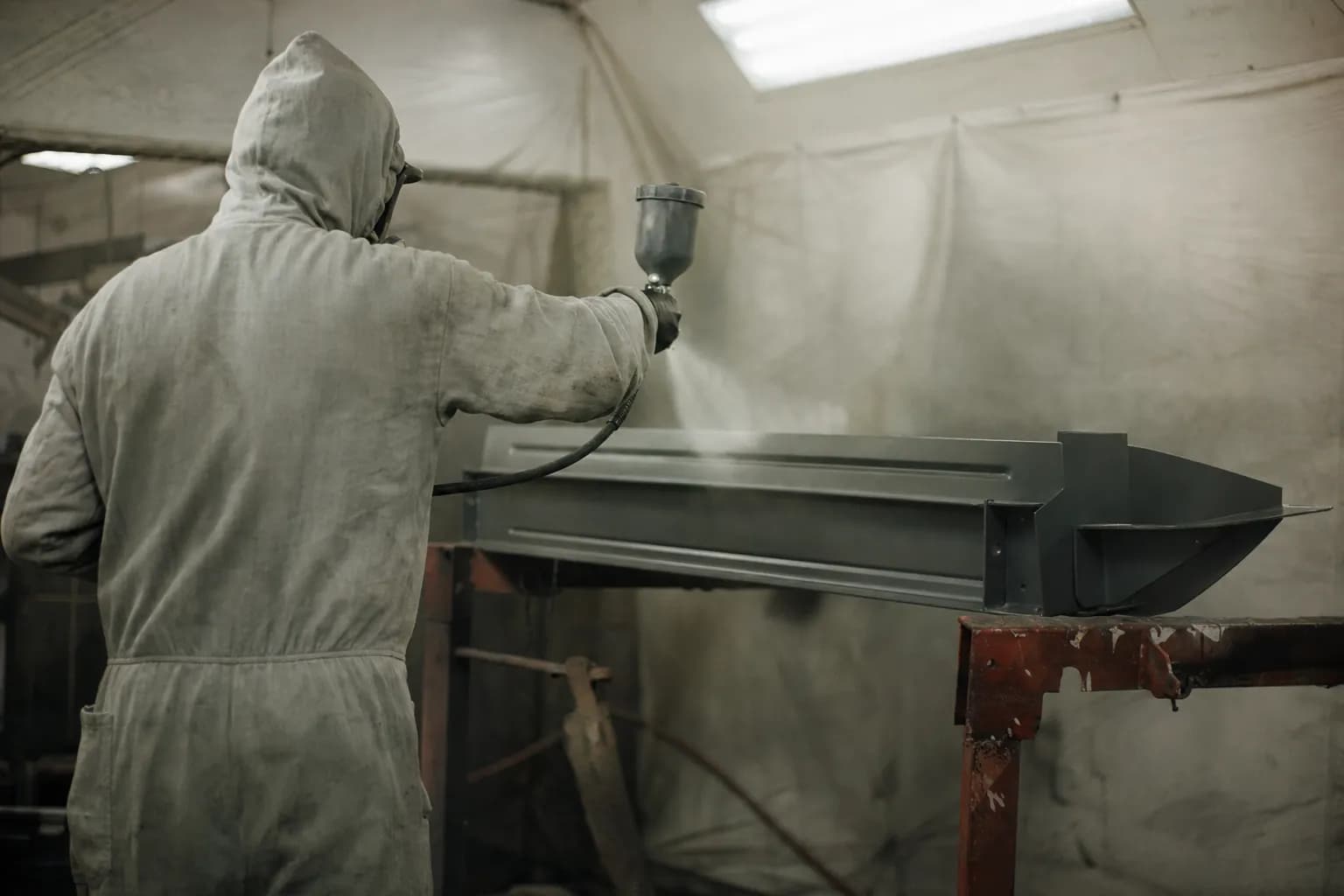
How work moves in industrial finishing and coatings
A job starts when parts arrive at the dock or a customer calls about coating something too big to move. In the shop, receiving counts what came in against the customer's paperwork and flags damage. The order desk writes up the job: the coating system, color, thickness range, masking and plug locations, cure schedule, packaging and due date. That becomes a traveler, paper or screen, that follows the parts through prep, blast, pretreatment, coat, cure, inspection and packing.
Field coating runs on a different clock. A crew goes to a plant, tank or structure. Weather and surface conditions decide what gets done that day, and readings are taken where there is no desk. The foreman's notes, photos and readings come back at the end of the job, sometimes at the end of the week.
Both sides end the same way. Someone assembles an inspection record or certificate for the customer, ships or closes out the work, and bills it. Rework, holds and customer-caused changes sit on top of all of it.
Where it usually breaks
The spec does not travel with the parts
The customer's masking drawing is in an email. The color change they called in is in the order desk's head. The traveler says the coating and the due date, and the prep crew fills in the rest from memory or from the last time. That is the handoff gap, and it shows up as parts that are masked wrong, coated in the wrong order, or held for a question someone could have answered at order entry. The guide on promises that never reach the crew covers how to trace where the note stopped.
Nobody can see where a job is on the floor
Parts sit on a rack waiting for cure, waiting for inspection, waiting for a customer answer. The office cannot tell which, so every customer call becomes a walk to the floor. That is the invisible queue. The guide on finding a job's status without a phone call has steps you can run this week.
Readings get written twice
Thickness and adhesion readings go on a clipboard at the booth or a notebook in the field. Later, someone types them into the certificate, the job record and sometimes a customer portal. Each copy adds a delay and a chance to transpose a number. That is the re-entry trap, and the guide on service reports that take hours to write up walks through the same problem from the report side.
Rework and customer changes are handled by phone
A part fails inspection, or the customer changes the color after pretreatment. Who decides whether it is rework or a billable change? Often that is settled in a hallway and never written down, and the extra labor never reaches the invoice. That is the exception swamp. See the guide on extra work that never gets billed.
The first workflow we usually look at
Order entry to traveler. It is the point where the most is known about a job and the least is written down in a form the floor can use. We watch a few jobs go from the customer's PO and drawings to the first operation on the floor, and we note every question the prep crew or booth operator has to ask. Those questions are the workflow's real spec. When the order desk captures those answers once, in the job, the traveler carries them, and inspection and shipping inherit them.
If the bigger pain is downstream, the second candidate is inspection to certificate: readings captured at the booth, attached to the job, and turned into the customer's record without retyping.
The systems in the picture
A finishing company usually runs some mix of these:
- An ERP or shop management system for orders, jobs and billing
- An accounting system, sometimes separate from the ERP
- Paper or printed travelers, and whiteboards on the floor
- Inspection gauges whose readings are written down by hand
- Spreadsheets for scheduling the line and tracking holds
- Email and customer portals for drawings, specs and change requests
- Phones and group texts for field crews
What a Workflow Spec looks like here
A Workflow Spec in a finishing company is $15,000, fixed, and done on site. We stand at receiving, the order desk, the prep area, the booth and inspection, and ride along with a field crew if the workflow reaches them. We interview the people who touch the job, measure how long one real job waits at each step today, and map where the spec, the readings and the changes get lost. You get the workflow map, the business case, an adoption design for the crew who would use the tool, and a fixed proposal for building it. The answer can be no. Details are on how we work.
Questions people ask
Where do finishing shops usually lose time?
At the handoffs. Receiving, the order desk, the prep crew, the booth, inspection and shipping each hold part of the job, and the traveler rarely carries all of it. Rework and holds often trace back to a spec note that never left the office.
Do you replace our shop management or ERP system?
No. Any tool we build reads and writes through the systems you already run and never becomes a second system of record for jobs, parts or billing.
Can you help with field coating crews as well as the shop?
Yes. Field work adds site access, surface prep conditions and readings taken far from the office. The Spec maps whichever side the broken workflow lives on, and where the two meet.
What about inspection readings and certificates?
Readings taken at the booth are often written on paper and retyped into a certificate later. Capturing them once, against the job, is a common first workflow because it touches quality, shipping and billing at the same time.
Have you worked in this industry before?
Yes. WERCS Inc. is a reference for Fox & Santiago in industrial finishing. The case is written up on the proof page, measured only where it was measured.
Next step
Talk to us
Start with a free twenty-minute fit call. If the workflow, the sponsor and the path to access are real, the next step is a Workflow Spec.
Fox & Santiago, Genesee, Idaho. Home territory: the Inland Northwest, where we respond fastest. We fly anywhere in the United States for paid engagements.