Industry
HVAC and mechanical contractors
In HVAC and mechanical contracting, workflows usually break between the service call and the invoice: parts, hours and findings leave the truck on paper or in a technician's memory, and the office rebuilds them days later. Fixing one means the ticket a technician closes already holds what billing, the maintenance program and the customer need, so nobody types it twice.
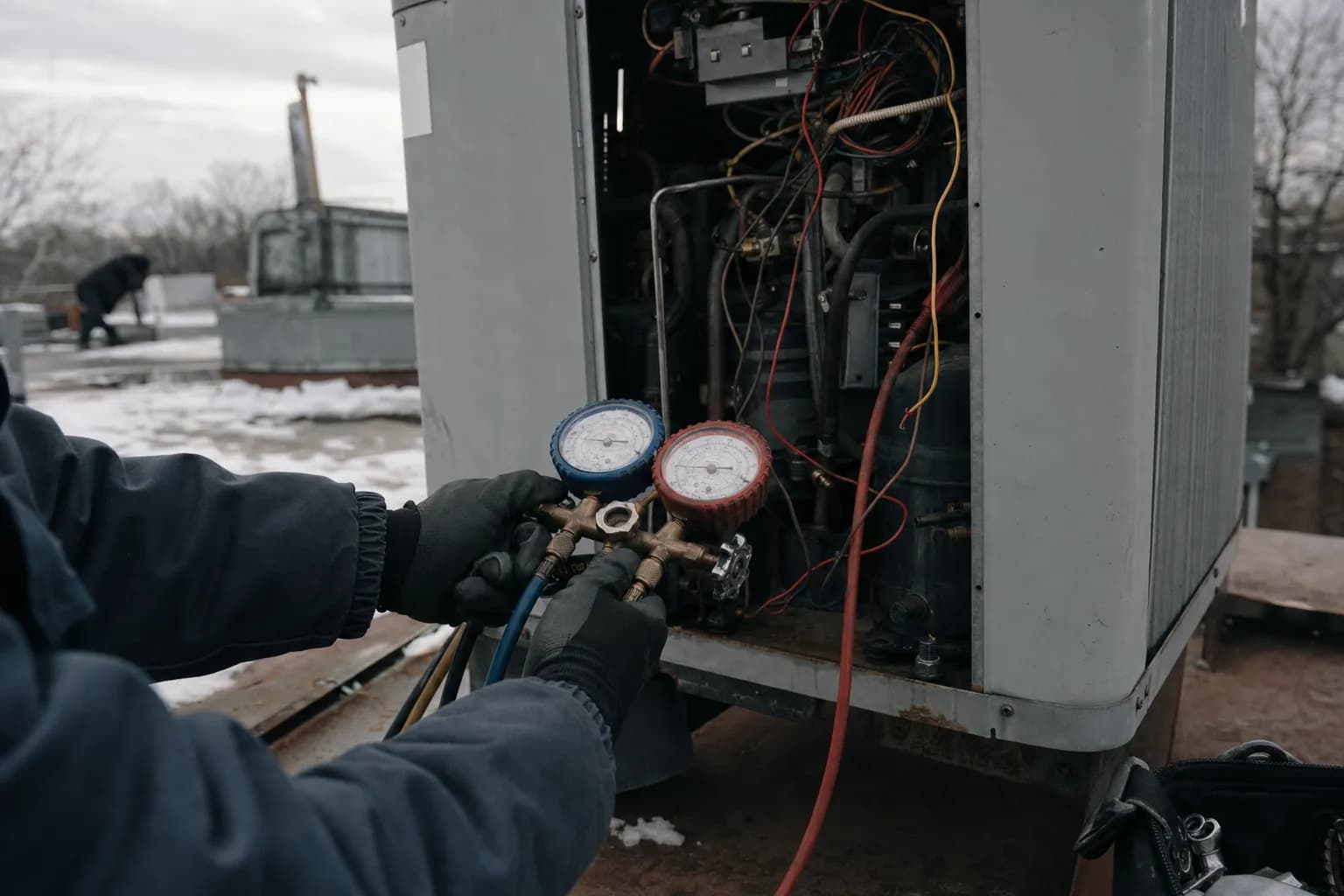
How work moves in HVAC and mechanical contracting
Most mechanical contractors run two businesses under one roof. The service side lives on calls: a no-heat or no-cool call comes in, a dispatcher slots a technician, the technician diagnoses, repairs or quotes, and the ticket comes back to the office to be priced and billed. The project side lives on bids, submittals, equipment lead times, change orders and a foreman's daily log.
Between those sits the maintenance program. Agreements promise a number of visits a year, filter changes, coil cleaning and startup checks, and they are what keeps technicians busy when the weather is mild. The people in the picture are a dispatcher or service manager, a mix of senior technicians and apprentices, a parts person or warehouse, a service coordinator who turns tickets into invoices, project managers, and an accounting team at the end of every line.
Seasons shape everything. The first hot week or the first cold snap floods the phones, and every weak spot in the workflow shows at once.
Where it usually breaks
Parts leave the truck and never reach the invoice
A technician pulls a capacitor, a contactor and some refrigerant from truck stock, writes it on the ticket or does not, and moves on. The office bills from what it can read. Stock on the truck drifts from what the system thinks is there. This is the re-entry trap, and the guide on parts used on jobs that never reach the invoice walks through how to measure it.
Maintenance visits lose to every emergency
When the phones light up, the planned visit is the easiest one to move. Nobody sees how far behind the program is until a customer asks why nobody came. That is an invisible queue. See preventive maintenance visits keep slipping and emergency calls wreck the planned schedule.
Service reports are written twice
The technician knows what was wrong and what they recommended. The customer gets a report typed later by someone who was not there, from notes on the back of a ticket. Recommendations for replacement equipment get lost on the way to whoever should quote them. This is the handoff gap, covered in service reports take hours to write up.
Project change work is settled by phone
On the project side, a foreman agrees to reroute duct around a beam that was not on the drawings. The conversation happens on site. The paper follows, if it follows at all, and the billing happens months later in a fight. That is the exception swamp.
The first workflow we usually look at
For a company with a real service department, it is usually the path from a closed service ticket to a sent invoice. It happens many times a day, it touches the technician, the service coordinator, the warehouse and accounting, and every gap in it shows up as money billed late, money never billed, or a customer calling about a bill that does not match what the technician told them.
We follow tickets from the moment the technician marks the job complete to the moment the invoice goes out. We count how long each one waits, where it waits, and what gets typed more than once. Sometimes the answer is a different workflow, like maintenance scheduling or quote follow-up on replacement recommendations. The Spec decides that from what we see, not from a template.
The systems in the picture
A typical mechanical contractor runs an accounting system, a field service or dispatch app on the technicians' phones or tablets, estimating for bid work, and sometimes an ERP that ties service and projects together. Around those sit the spreadsheets that hold maintenance agreements, truck stock counts and warranty registrations, and a fair amount of paper: tickets, startup sheets and signed work authorizations.
We do not replace any of these. A tool we build reads from and writes to what you already run, so it never becomes a second place the truth lives.
What a Workflow Spec looks like here
A Workflow Spec is $15,000, fixed, and it happens on site. We ride with technicians, sit next to the dispatcher on a busy morning, watch the service coordinator build invoices from returned tickets, and interview the people who touch the workflow from the call to the payment. At the end you get a map of how the workflow runs today, where it leaks, the business case for fixing it, how the crew would actually adopt a fix, and a fixed proposal to build it. If the honest answer is that it is not worth building, the Spec says so.
Questions people ask
Do you work with the service side or the project side of a mechanical contractor?
Either. Most companies we talk to start on the service side, because service tickets repeat every day and small leaks there add up fastest. Project workflows like change orders and submittals are just as fair a starting point.
Our maintenance agreements live in a spreadsheet. Is that a problem?
Not by itself. It becomes one when the scheduler does not look at it daily and visits owed quietly age. The Spec checks whether that is happening in your shop before anything is proposed.
Our busiest season makes everything worse. Should we wait for the off season?
The Spec is easier to schedule in a shoulder month, but seeing the workflow under real load is useful. We time the site visit with you so it does not pull people off calls when they are needed most.
Will our technicians have to learn another app?
Only if the Spec shows that is the right answer. Often the fix sits inside the field service app they already carry, or reads from it, so the technician does less, not more.
Can you help with the paperwork for equipment and refrigerant work?
We can make sure what the technician records reaches the right record without retyping. We do not interpret what any rule requires. That stays with you and your advisors.
Next step
Talk to us
Start with a free twenty-minute fit call. If the workflow, the sponsor and the path to access are real, the next step is a Workflow Spec.
Fox & Santiago, Genesee, Idaho. Home territory: the Inland Northwest, where we respond fastest. We fly anywhere in the United States for paid engagements.